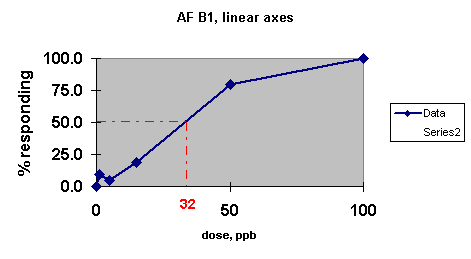
Aflatoxin B1 is the carcinogen in peanut butter, at least some peanut butter, sometimes. Here is dose-response data. The response reported is animals with at least one tumor. Note the dose is in parts per billion. (We'd have to go back to the original papers to find out more, but clearly its a very small dose.)
|
Aflatoxin B1
|
|||
|
Dose (ppb)
|
Animals w/ tumors
|
Animals tested | % w/ tumors |
|
0
|
0
|
20
|
0
|
|
1
|
2
|
22
|
9.1
|
|
5
|
1
|
22
|
4.5
|
|
15
|
4
|
21
|
19.0
|
|
50
|
20
|
25
|
80.0
|
|
100
|
28
|
28
|
100.0
|
First, let's examine the data. The "0" dose is the control. It's not uncommon to see an effect, even in unexposed animals. Had there been 1000 animals in the control group, some of them surely would have had tumors. Now look at the tumors in the 1 ppb and 5 ppb dose groups. It would appear that 1 ppb is more toxic than 5 ppb. What is the significance of this? Probably nothing. Such anomalies are common in animal testing.
Now let's look at a graph of the data.
We are tempted to be done with the data here, but you recognize that we have based the estimated of ED50 on only two data points, those on either side of the 50% response, 15 ppb and 50 ppb in this case.
A different approach, that takes all the data into consideration, is to use linear regression to find the best straight line fit of the data, then decide the 50% response based on that. Here is Excel with the calculations and a graph: Excel, Excel95
Resize the frames and scroll to the right to see the calculations that got an ED50 of 42 ppb. Here you recognize that all the data was taken into account, but that it shows a finite response at 0 dose, which is not correct. (Had there been effects in the controls, the data would have been adjusted prior to this, and it should show zero effect at zero dose.) Also it would show a nonsense, 110% response at 100 ppb dose. On the other hand, the linear regression programs give you lots of nice parameters, like r squared, and percent confidence level. But, again, you realize these statistics are only mathematical manipulations of the linear regression formulae and the data points, they might not be biologically relevant. We'll get back to regression in a few pages.