Here we test 9 batches of animals, perhaps with 10 animals per batch, each
at a different dose. Here is what we get:
| |
|
|
Dose (mg/kg)
|
% Responding
|
|
1
|
7
|
|
6
|
11
|
|
20
|
15
|
|
50
|
30
|
|
100
|
50
|
|
200
|
70
|
|
300
|
85
|
|
500
|
93
|
|
800
|
99
|
|
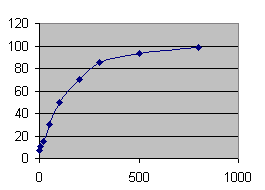 |
|
Dose on a linear scale
|
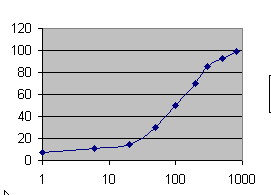 |
|
Dose on a log scale
|
The response plotted against the log of the dose, yields (with a little imagination)
an "S" shaped or sigmoidal curve. Note that it is more or less straight
between about 15% and 85%, this is commonly the case. Now for each dose, take
the percentage that responded at that dose, for example the 15% that responded
at 20 mg/kg, and subtract the 11% that responded at the next lower dose and
you get 4%. If we plot that percentage affected by the higher dose versus the
log of the dose we get:
 a histogram, that looks a
lot like a normal distribution. In fact, a normal distribution is what you would
expect. There are a few very sensitive animals and a few very resistant animals,
but most are somewhere in the middle. Since we believe that this is the most
common distribution of reactions, we can use it to develop a more accurate method
of determining the LD50. In real life we seldom have enough test groups, especially
for cancer assays that take a year or so. Often we find only two or three doses
for which we have a response. (More on that later.)
a histogram, that looks a
lot like a normal distribution. In fact, a normal distribution is what you would
expect. There are a few very sensitive animals and a few very resistant animals,
but most are somewhere in the middle. Since we believe that this is the most
common distribution of reactions, we can use it to develop a more accurate method
of determining the LD50. In real life we seldom have enough test groups, especially
for cancer assays that take a year or so. Often we find only two or three doses
for which we have a response. (More on that later.)
The method is to convert the response data from percentages, to "normal
equivalent distributions." For example, in a normal curve, 50%, the mean,
15.9% is one standard deviation to the left and 84.1% is one standard deviation
to the right. This would send you to your old statistic book in the old days,
but Excel has a function NORMSINV which computes it for you, just change
the percent to a decimal and plug it in. Since half the numbers will be negative,
you can add five to all of them and the new unit is called a probit.
So if 15.9% of the animals died, you convert that to 4 probits, if 85% died
that converts to 6 probits. The result of this process is to "straighten
out" the sigmoidal curve into a nice straight line. Here is the process
in Excel (Excel
95)
From here you can do linear regression and find the ED50. This process puts
the investigation of LD50 on a basis of biologic reality, the notion of the
normal distribution of sensitivities and resistance. How would it look for the
AflatoxinB1 data from the earlier page? Look here in Excel
(Excel 95).
Not so hot, huh?
So for the Aflatoxin data, we have ED50's
|
Method
|
ED 50
|
| Direct from the Data |
32.8 |
| Via Linear Regression |
42.4 |
| Using Probit |
15.6 |
So for the LD50/ ED50 which is the "correct way" to compute the number?
Sometimes an agency will tell you, often there is a pecking order, you start
with probit, the preferred method, then use the others if probit won't work.
For probit you need at least two data points with partial effects, that is more
than 0% affected, but less than 100% effected (although you can fudge the 100%
by using 99%). So how much does this have to do with cancer studies? Typically
very little, as you will see in Module 5B.
You can use the same rational to compute LD15 and LD85, but they get shaky
further out, which we'll talk about later, although similar methods are sometimes
used for LD10 and LD1. For many purposes, however, not the LD50/ED50, but rather
than NOEL and LOEL are used. NEXT